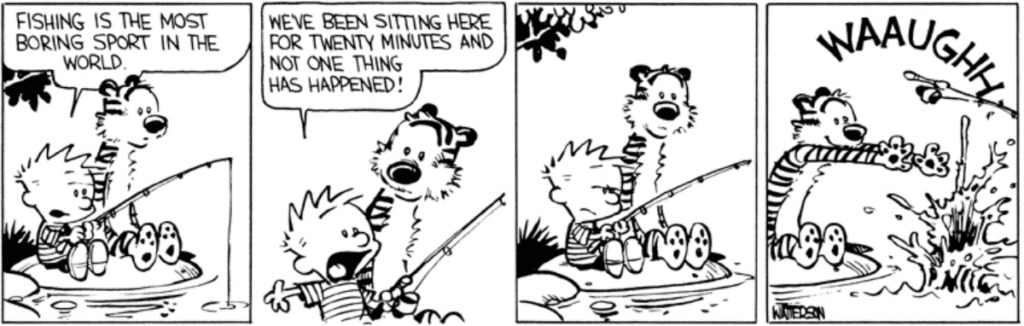
My last fishing trip was a chartered, 3-hour-tour into Lake Michigan. Thick fog delayed us, then obscured any view. Despite half a dozen complicated (and presumably expensive) fishing poles in the water… we got completely skunked. Not a nibble.
I vowed that on my next trip, I would make like Hobbes…
Fortunately, my next fishing trip was with the Indiana DNR. They were surveying for Largemouth Bass and were short on help. Fortunately, I didn’t have to pull a Hobbes and create unnecessary excitement. We were going electrofishing! No hooks, just electrodes and a current…
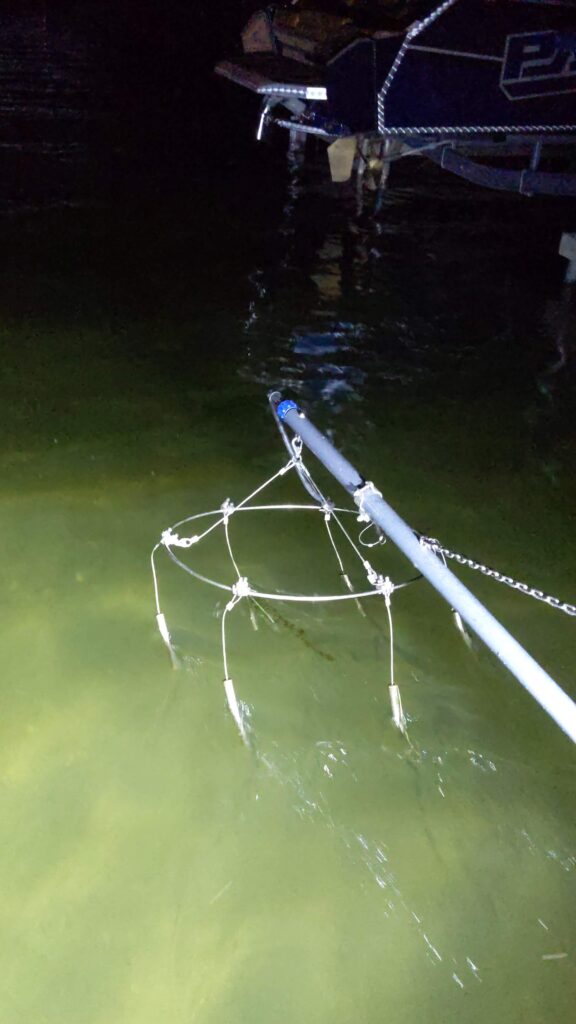
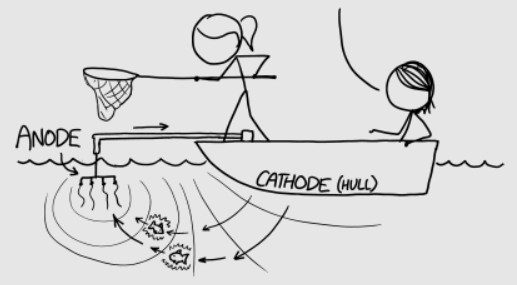
That dangling electrified chandelier is the positively charged anode, and the bottom of the boat (the paint scrubbed off) acts as the cathode. Current flows between them, and you troll forward at a fixed rate for a fixed period of time. Fish will be stunned for just a couple seconds, so you have to scoop fast. Afterwards, they shake it off and swim away, apparently none the worse for wear.
Repeat this process in the same manner at the same time of the year, and you can get a picture of the relative abundance and distribution of your target fish.
In addition to being a key predatory freshwater fish, Largemouth Bass are important culturally as a commonly pursued gamefish. Anglers contribute to the DNR by taxes and license fees, so gamefish are given some extra attention. The DNR then uses their judgment as to the frequency and location of fish surveys. That’s fisheries management in action!
Walleye were also present, but since they weren’t our subjects for the day, we just didn’t scoop them or dropped them right back. Bass were temporarily held in the livewell in the boat.
I asked why we went out at night. Not to be a weenie, but I was getting pretty tired by 11 PM, with only the cold and dampness to keep me awake. I was told that it’s actually because they don’t see us as easily as night. Really!
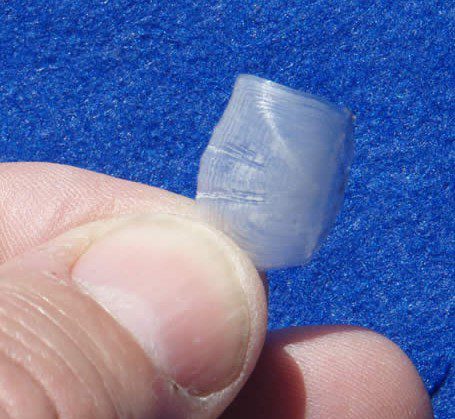
Once we completed a 30-minute sampling, we idled the boat and measured the fish. I wrote down the species and length. For some of them, we also used a knife to take a small scale sampling, which we packed in a paper envelope.
Back at the lab, they would age the fish by observing the growth of the scales, like so:
Ok, on to the results!
They noted: “The effort for this survey consisted of 3 hours of active sampling. A total of 197 black bass were
collected during this survey with 142 being Largemouth Bass and 55 Smallmouth Bass. Of the bass collected,
Largemouth Bass averaged 13.2 inches in length while Smallmouth Bass averaged 6.8 inches. Largemouth
Bass reached legal length (14.0 inches) by age 4 and the majority of Largemouth Bass collected were between
14 to 16 inches. The majority of Smallmouth Bass collected were between 4 to 7 inches and reached legal
length by age 5. Bass are self-sustaining and do not need subsequent stocking, while Walleye have been
stocked in Lake Maxinkuckee annually since the 1980s.“
I asked DNR why the Smallmouth Bass were substantially shorter than the Largemouth. They said, “It’s likely got to do with a bit of a mismatch in sampling gear and the Smallmouth Spawning preference. They tend to bed on harder substrate in 6-18 feet of water while electrofishing is only really good to about 6 feet. That could explain the smaller number of large Smallmouth Bass caught compared to the Largemouth Bass. We were also there during water temperatures that were more suited to Largemouth Bass rather than Smallmouth Bass spawning activity.”
Habitat, sampling effort, timing, weather… all of these have effects on the data. For these reasons, you wouldn’t want to read too much into a single sampling, or drastically change or management strategy. But you do want to repeat these efforts can consider all of the factors at play.
I’m glad that we have ecological professionals on the state payroll who have studied these things in depth and continue to be vigilant about the status of our fisheries.
(The full report is below. If it’s hard to view, try clicking the download button).
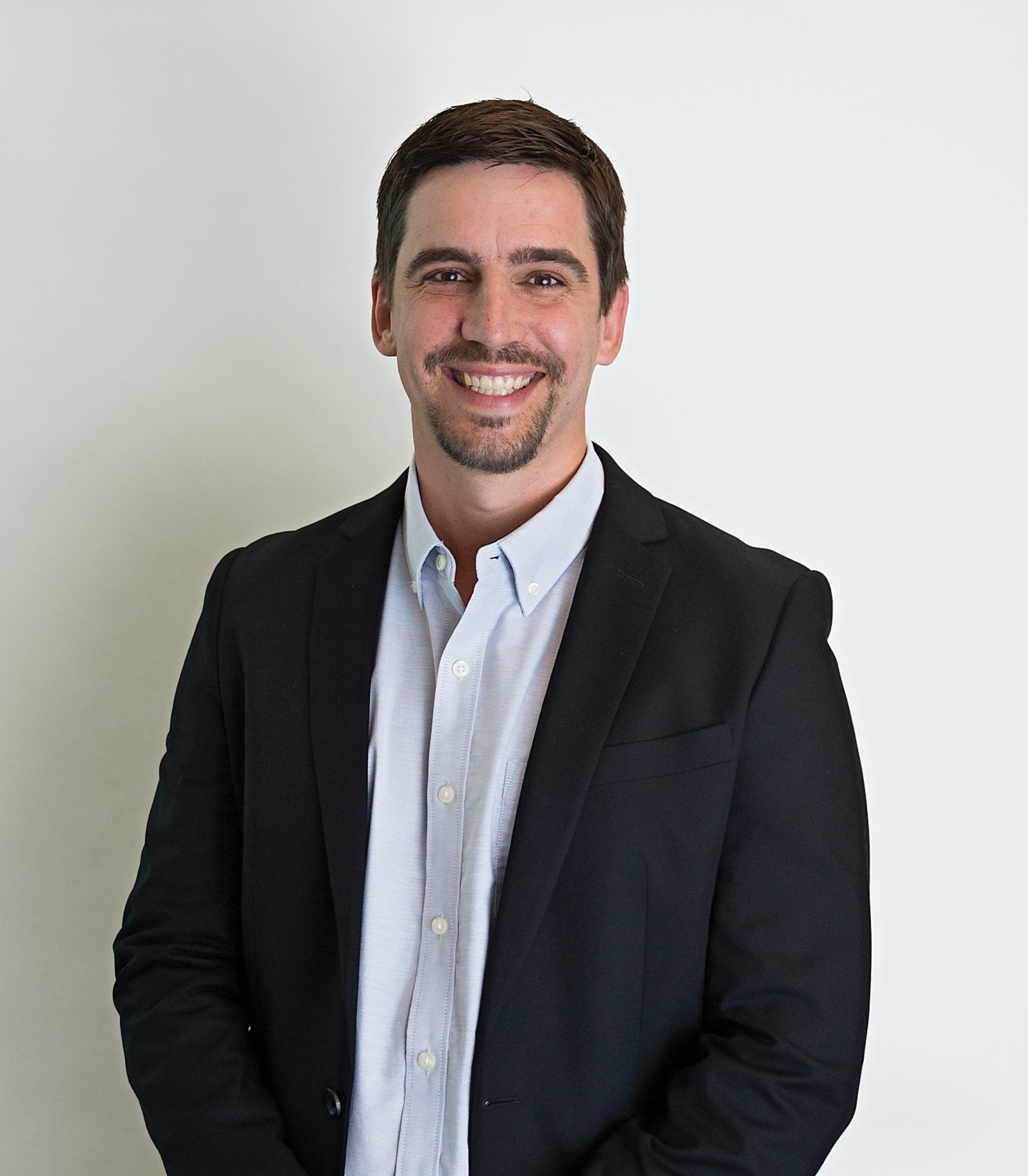
Hi, I’m Adam Thada, President of the Lake Maxinkuckee Environmental Fund in Culver, IN. I studied Biology (BS) at Indiana Wesleyan University and Environmental Science (MSci) at Taylor University. The last decade or so has found me in Northern Indiana, working in sustainability, environmental education, and ecological restoration.
Recent Comments